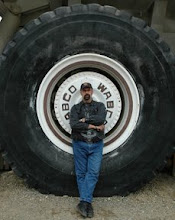
The Big Wheel

The Big Wheel
I appear bigger in real life.

Tuesday, January 10, 2012

Oddments


And welcome to the New Year.

I thought I would start off the year by finishing up or building on a few bits from the past postings, kind of like leftovers from the photographic fridge (and I really did keep film in the fridge way back when the great yellow box Kodak was king).

My last postings were mainly about aspects of photography; what I did on my vacation, where I like to shoot and what I like as subject material (which as I said can be a lot of things). Also I think of myself a funny guy (maybe I should say a guy with a sense of humor) and that sense can apply to things I see and photograph.

Here’s an example, I took a photograph of a beautiful old MG on the street. I really liked the car, the photograph turned out well too. But there was something more in the photograph that I don’t think many people see. If you look closely in the chrome you’ll begin to pick out lettering. Now this is backwards but if you look you’ll see TOYOTA. When I shot this I was, as I said, on the street and across from a Toyota dealership.

MG on Queen Street, Toronto, ON

I haven’t been as much into infrared photographs as I once was. Part of the issue with me is that I usually don’t carry around a tripod when I’m oot and aboot on hikes and the filter required to take ‘digital’ infrared photographs requires extremely long exposures, way beyond my capacity to hand hold the camera. I thought I’d include a couple infrared photographs here partly to hang up a couple images on the digital wall and partly just to revisit the images.

Schmendrick

One image I like very much (and a copy of it used to be in a bank in Barrie, ON of all places) is of a cat I had by the name of Schmendrick.

Ties and Weeds

The other infrared image I’m including here was taken in a vanished space, the old railroad yards in downtown Toronto. It’s just a bunch of ties and a weed growing up against it but because of the infrared effect it makes it almost magical to my mind and the gap in the ties becomes a window to a different reality.

Tree at the rim of the Grand Canyon

I’ve talked about my love of the black and white photograph in past postings and I’ve included a couple of images from the vault that I’ve always liked. The first is of a tree that was situated at the side of the Grand Canyon. I think this may have been the shot I was taking when I lost a lens cap over the edge.

Montezuma's Castle

Another area that fascinated me, like many other archeological sites, was the area called ‘Montezuma’s Castle’ (although as I recall the big ‘M’ never actually was there). I would have loved to be allowed to wander through the dwelling but never had the opportunity to do so. Here is an overall view of the site.

Canyon Country

Another image from the American west is basically a landscape portrait. This features another aspect of  the photograph that I liked to play with, grain. In many of the infrared photographs I’ve already included in the blog you can see how grain plays an integral part in the creation of mood. I used grain for much the same reason in more ‘normal’ black and white photographs as in this instance. I used particular developers when I developed the film in order to enhance the effect. Images don’t always have to be, well sharp or clear doesn’t exactly cover what I’m attempting to say, they can also be, hmmm, I guess I’ll just have to say textured. I hope that works.

Sunday, November 20, 2011

The Social Gathering


At every social gathering, and usually one which involves some kind of alcohol, there's someone who thinks wearing a lampshade, a funny hat, yes and even a flower pot, is a good idea.

Saturday, November 19, 2011

Shorelines

Along the shoreline of Stanley Park, Vancouver, BC

 Since I have some time on my hands (don’t ask) I thought I’d add another page to my blog. I thought to continue writing (and throwing pictures on the screen) about the things that grab me photographically. So, I’d like to take this opportunity to talk about shorelines and what the camera discovers when it takes me for walks along them. I might even show you a couple of different things I’ve been working on. One of these was mentioned in an earlier posting as difficult subject matter to translate into a viewable image, the nefarious ripple effect.

Ripple study #1 - Bluffers Park, Scarborough, ON
Ripple study #2 - Bluffers Park, Scarborough, ON
Ripple study #3 - Bluffers Park, Scarborough, ON

I’m also going to take the opportunity here to thank in person another individual who has been a good friend over the years (and you can tell those people from others you have met because they are the ones who, in spite of the circumstances of extenuation, still manage to keep in touch). Here’s to you Walter Borchenko.

Walter and the figures of the Guild Inn

A further other but not entirely different reason to write is to tell you about this incredible image software that I have been allowed to play with, thanks to the above-mentioned individual.

I have been a Photoshop user for a number of years. As most people in the photographic industry are aware it has been considered the standard in image manipulation. I don’t claim to actually be proficient in this software. I have a tendency to use a few tools to get a certain effect, or to get rid of some annoying detail, and that’s about it. Print it, that’s a wrap.

Well I am exploring a few of the possibilities of a new piece of software (new to me).

Now a disclaimer: There are certain frustrations in being a dabbler in the art. A big problem, at least for me, is trying to figure out how to wade my way through software; to make it through and around all the selection menus and dialogue boxes to make the software do it’s tricks for you. Part of the difficulty is because of my prior preconceptions or prior mental lockdown due to my own Photoshop mentality. And admittedly I’m getting, as they say, long in the tooth. I may not be as spry in the mental gymnastics department as I once was.

So this is a ‘hats off’ to the Capture One software. I am so new at it that I don’t feel knowledgeable enough to talk about it here. Let’s just say that I’m impressed. There is enough information on the net and demonstrations on You Tube to give you some idea as to its workings.

Oh, did I mention anywhere that for the past few years I’ve been shooting in NEF format? It makes a difference, particularly with this software (and I think it does a much better job than Photoshop in handling the files).

And back to the shoreline.

I like water. If you’ve followed this blog you already know that I’m from Niagara Falls, Ontario, a city named for water basically. Well, yes, it’s named for where the water, um, falls over an escarpment, but that’s quibbling.

I’m living at the moment in Scarberia. I don’t know if I’ve let you into this joke or not but the name of this city within a city is actually Scarborough, to the east of Toronto and now incorporated into the metropolis. Scarberia is one of the nicknames that we denizens apply to it.

I’m sorry but in many respects I consider the landscape of Scarberia to be boring except for a couple of notable exceptions (which happen to co-exist in close proximity), which are the Guild Inn and the Scarborough Bluffs.

Cathedral Bluffs, Scarborough, ON

I’ve already described the Inn in detail. The bluffs are basically a chalk and sand formation located on the shoreline of Lake Ontario. I’ve walked the shore here a number of times, often accompanied by my brother Ralph, and almost always with camera.


Bluffs and the shoreline, Scarborough, ON

Cathedral Bluffs, Scarborough, ON

I still identify myself, by and large (no weight jokes please), as a black and white photographer. That was one of the reasons why I started taking photographs in the first place lo these many years ago. I loved the whole process and I have always loved the look of the images. And in this context I still shoot things with that in mind, particularly the logs and driftwood and other ephemeral features that lay close to shorelines.

Sandshark Log, Stanley Park, Vancouver, BC

My recent trip to Vancouver gave me the opportunity to explore the shoreline surrounding the city, particularly Stanley Park on Burrard Inlet off the Strait of Georgia. That is where many of these images came from.


Driftwood pattern, Stanley Park, Vancouver, BC

Lionshead Driftwood #1, Jericho Beach, Vancouver, BC

Lionshead Driftwood #2, Jericho Beach, Vancouver, BC

Shattered wood detail, Stanley Park, Vancouver, BC

And the new software, Capture One, allows me to seriously play with the digital images, including converting them to black and white (and even toning them if I desire). It’s as if I were back in the darkroom, back in the old days (yeah, and when you think about it they weren’t all that long ago) with all the beakers, trays and chemical baths, the enlarger, easel and safelight, burning and dodging and then processing the paper to see what it held. It’s brought much of the magic and the craft back to realizing the images that were shot in camera.

Thanks Walter.

All photographs by Colin Campbell

Saturday, November 5, 2011

Dilapidation

The Dovecote at Uxmal in the Yucatan Peninsula

Another view of Uxmal

 This is another posting about photography and what I like to photograph. I shoot a lot of different subject matter. If it looks interesting somehow and I have my camera I’ll photograph it: fungus and pipes, cogs and logs, colors and textures. Not so many people though (although I was conned into shooting a wedding this June). I’m not the only person who likes to shoot this kind of thing. Right Sid?


This posting is also an excuse to hang up a few images in my digital room.

The Amphitheater at the Guild Inn

Recently, in the past few years that is, I’ve started to look at things in a different way. I might shoot something now just for the color(s) that I see, or for the texture(s), maybe a pattern. I find that it’s interesting then to see how what I saw is transformed into pixels, the new technology. Sometimes that’s where frustration sets in, because of the difficulty of translating what is seen, separated from the real world context, into an image that then can be shown.

Still, as one photographer said, they photograph in order to see what the world looks like photographed.

Abandoned house, Curve Lake, ON

Handyman opportunity, found on a back road

Here’s an example: I spent some time trying to photograph the ripples in a streamlet that ran parallel and fairly close to Lake Ontario because of the patterns they created, shadows of the ripples in this streamlet over the sand and pebbles. I’m thinking ‘moirĂ©’ patterns here, sort of interference patterns. I took quite a number of different photographs from a number of different angles. I thought it was very interesting and quite beautiful. Now, here is where the frustration came in, I still haven’t been successful at getting those images to view right, and I’m still working on that one.

Infrared shot of tires and barn wall

So, subject matter varies… greatly.

That being said I still like to photograph what might be encapsulated by the term ‘dilapidation’, the title of this post. What the word means, if you’re not familiar with it, is things falling apart from lack of care. I think my online dictionary says something about disrepair or ruin.

Hey, that sounds like me. I’m fascinated by those places and things which have been built, lived in and/or used by people but that are now abandoned, discarded, rusted, burnt, buried, sunken, collapsed, shunned, and weathered. I also like to see how the environment reclaims the abandoned and the decaying.

Barbecued Doors

Same farmhouse, stairway to second floor

I love to explore old abandoned barns and farmhouses. Well, I’ll explore any house or building falling into decay really, but the country versions just seem to hang around longer and are usually not quite so chained or gated off from the public.

Muskoka farmhouse

Roof needs a bit of work

I like to photograph abandoned cars and trucks in fields, for much the same reason that I like the farmhouses in these sites/environments. I think that the location helps to isolate the subject.

And some things are photographed just because they tweak my sense of humour.

Sign from repair shop in Ida, ON. It says 'repairs bodies'.

So I’ve thrown together here quite a mixed bag of images. I hope you enjoy them.

 Now if I can just get the damn ripple shots to come out better...


From Seattle's underground city, Sam's sign.

Also from the underground, an actual bathtub gin bathtub
House and bathtub from N'Awlinz featured in a Campbell Brothers' story.

Causeway destroyed by Katrina

Boat stranded on shore from a previous hurricane.

U.S.S. Cairo, Union ironclad gunboat, Vicksburg National Military Park

Crane and gator, Squamish, BC

Is it is or is it ain't a Volkswagon?

Just resting
Pick-up in a field

Same truck, rear view

Old car and door, Oatman, Arizona

Car doors, again near Oatman. This is one of my favourite shots and is a great print.


Thursday, November 3, 2011

What I did on my summer vacation - part the third

So, the carousel blew my (admittedly) wee mind. After I had finished doing my thing with the carousel we wandered out the rear door and discovered...


The Burnaby Village Museum


This site, which we didn’t quite stumble across (but it was close), is advertised as a10-acre open-air museum (circa 1925). Wow, that’s cool too. It turns out that this little ‘town’ has more than 30 shops and homes, including a movie theatre, blacksmithy, bakery, newspaper and an Ice Cream Parlour.


Oops, lets back up. Even before we got to the village proper, for want of a better word, the first building that we encountered was one that housed the 1912 B.C. Electric Railway interurban tram (#1223).


Now I’m a bus driver, and I have been for several years, so I know somewhat about creature comfort and the transit of masses. This electric train (albeit a big one), I really liked. The interior of the car glowed with the warmth of the incandescent lamps and the glory of polished wood. It sure showed an interest in detail that I think you seldom find in transit vehicles these years.


So Sid and I wandered these streets, photographing the scenes, and even got the chance to wander behind the scenes. We took the time to watch a blacksmith at work (and yes, took a couple of pictures of her at the anvil). Can you tell that I enjoyed the whole expedition?


And again, in praise of off-season visitation, there were few actual people on the streets or in front of my lens.

Note: I wanted to thank Sid, for a lot of things really, but for making me think about photographs and about photography as a whole in this latest outing. I haven’t been taking many photographs recently, even though I enjoy it and identify myself with it. I needed a refresher course.


What I’m getting at here is that Sid showed me (again) that the principle of hand holding a camera under difficult lighting situations works. Sid taught me for a second time how to play around with the available light and of how to play with the ISO setting of the camera. We took many photographs, even inside the buildings (particularly the cannery which had sections that were quite dark), of pipes and machines and gears and assemblies, all kinds of stuff. Most of the flash photographs that I took have elements that I find are disconcerting, detracting, annoying. Hand holding the camera even captured the best shots of the carousel.

Me, behind the scene

Thanks dude. I owe you.